Doing the Continental: A New Canadian-American Relationship by David Dyment
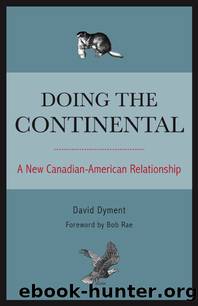
Author:David Dyment [Dyment, David]
Language: eng
Format: epub
ISBN: 9781525244889
Google: iofjswEACAAJ
Goodreads: 37117228
Publisher: ReadHowYouWant
Published: 2010-10-21T00:00:00+00:00
Notes
1. Peter Tertzakian, A Thousand Barrels a Second: The Coming Oil Break Point and the Challenges Facing an Energy Dependent World (New York: McGraw-Hill, 2006), 117; and Thomas L. Friedman, The World is Flat, A Brief History of the 21st Century (New York: Farrar Straus and Giroux, 2005), 407 and 411. Due to the sharp economic downturn production and consumption figures are of course forecast to drop significantly for 2009. Otherwise, the trends discussed in this chapter held for 2007 and 2008 according to a review in February 2009 of relevant statistics.
2. Ibid., 3; and Hugh McCullum, âFueling Fortress America, A Report on the Athabasca Tar Sands and U.S. Demands for Canadaâs Energy,â Canadian Centre for Policy Alternatives, March 2006, page 21.
3. A speech by U.S. Senator (from Utah) Orrin Hatch âHatch on Oil: World to Shift Focus to Unconventional Resources,â delivered at the Canadian Embassy, Washington, October 17, 2005, 1.
4. Don Gillmor, âShifting Sands,â The Walrus, April 2005, page 35. The U.S. has less than 2 percent of the worldâs conventional oil reserves and no new refineries have been built in the U.S. for more than ten years; from: North American Energy Working Group Security and Prosperity Partnership Energy Picture Experts Group, âNorth America â The Energy Picture II,â January 2006, 11 and Hugh McCullum, âFueling Fortress America,â 21.
5. From www.eia.doe.gov/neic/rankings/crudebycountry.htm; and Paul G. Bradely and G. Campbell Watkins, âCanada and the U.S.: A Seamless Energy Border?,â C.D. Howe Institute, Commentary No. 178, The Border Papers, April 2003, 3. One million six hundred thousand barrels a day from Canada is 15 percent of U.S. imports.
6. Ibid., 3 and 9.
7. Barrie McKenna, âAddictâs logic has oil-hooked U.S. in a fog about deficit realities, options,â Globe and Mail, 29 November 2005, B16; and Pierre Alvarez, President Canadian Association of Petroleum Producers, âEnergy,â a paper prepared for the Canada and the New American Empire Conference, University of Victoria, November 2004, 2.
8. These sources of energy are: oil, natural gas, coal, electricity, and uranium. Twenty-seven percent of the uranium the U.S. uses in the production of nuclear power comes from Canada, this is the equivalent of over 5 percent of total U.S. supply of electricity, from www.dfait-maeci.gc.ca â major issues, Canada-U.S. Energy Relations, Overview.
9. These figures come from Pierre Alvarez, âEnergy,â 1; and from Jerome Davis, âNorth American oil and natural gas, current trends, future problems?â, International Journal, Spring 2005, 429.
10. Monica Gattinger, âFrom Government to Governance in the Energy Sector: The States of the Canada-U.S. Energy Relationship,â The American Review of Canadian Studies, Summer 2005, 328.
11. Though exports of oil to the U.S. have increased dramatically, Canada continues to import oil to meet 90 percent of demand in Atlantic Canada and Quebec and 40 percent of the demand in Ontario. In 2005 Canada imported, mostly from Venezuela, almost one million barrels a day.
12. These percentages are derived from data in Monica Gattinger, 328.
13. Admittedly, significant advances in 2009 and 2010 in gathering natural gas found in shale deep underground may be transforming our understanding of natural gas supplies and the future of this industry.
Download
This site does not store any files on its server. We only index and link to content provided by other sites. Please contact the content providers to delete copyright contents if any and email us, we'll remove relevant links or contents immediately.
| Anthropology | Archaeology |
| Philosophy | Politics & Government |
| Social Sciences | Sociology |
| Women's Studies |
The Secret History by Donna Tartt(19092)
The Social Justice Warrior Handbook by Lisa De Pasquale(12191)
Thirteen Reasons Why by Jay Asher(8912)
This Is How You Lose Her by Junot Diaz(6889)
Weapons of Math Destruction by Cathy O'Neil(6281)
Zero to One by Peter Thiel(5802)
Beartown by Fredrik Backman(5759)
The Myth of the Strong Leader by Archie Brown(5509)
The Fire Next Time by James Baldwin(5449)
How Democracies Die by Steven Levitsky & Daniel Ziblatt(5219)
Promise Me, Dad by Joe Biden(5154)
Stone's Rules by Roger Stone(5088)
A Higher Loyalty: Truth, Lies, and Leadership by James Comey(4964)
100 Deadly Skills by Clint Emerson(4927)
Rise and Kill First by Ronen Bergman(4790)
Secrecy World by Jake Bernstein(4753)
The David Icke Guide to the Global Conspiracy (and how to end it) by David Icke(4720)
The Farm by Tom Rob Smith(4514)
The Doomsday Machine by Daniel Ellsberg(4490)
